Why My First AI Experience Failed
A few years ago I set out to prove that AI couldn’t help a paralegal do their job, and I proved it so thoroughly that I typed “That’s it. I give up.” to my AI assistant and walked away from the keyboard. A few months later I found out the failure was mostly mine.
That story is where my new book, Meet Your Robi: A Paralegal’s Guide to Making AI Your Most Valuable Assistant, begins, and it leads straight into a 15-minute fix you can make this week that will improve every AI conversation you have from here on out.
I’ll walk you through the whole thing, including exactly what to type and where to find the settings.
The Test I Set Up to Answer the Big Question
If you’re new around here, Robi is the name I gave my AI assistant. Back then, Robi lived inside ChatGPT and we were still getting to know each other.
Everywhere I went, people asked me the same thing. At conferences, in my inbox, and in the comments on LinkedIn, it was always “Ann, is AI going to take paralegal jobs?” I didn’t want to guess, so I set up a test.
I prompted Robi to act as a senior litigation paralegal and write a trial prep checklist covering everything from four months out to the day before trial. Then I ran that exact same prompt in Copilot and in Claude.
I picked trial prep on purpose. Inside my Trial Prep Boot Camp and Litigation Paralegal Boot Camp, there’s a trial prep checklist I built from years of doing this work, and it has around 120 items. I had an answer key, and I knew exactly what good looked like.
The scoreboard
Here’s how the results came in:
- The three AI lists: about 75 items, a little over 50, and a little over 40
- My request: combine all three into one complete checklist without duplicating tasks that were worded differently but meant the same thing
- Robi’s first combined list: 71 items, even though one of the lists I handed over had 75 on its own
- After I pointed that out: 68 items
- After I edited my original prompt and asked again: 65 items
By that last round I was typing with my whole chest, and when I finally wrote “That’s it. I give up,” Robi very politely apologized and asked if there was anything else he could do for me. 😂
AI Boot Camp for Legal Professionals
Master the essential AI skills you need to thrive in today’s legal industry in just 4 weeks – without getting lost in technical jargon! Don’t let another week go by feeling uncertain about AI’s impact on your career. Take the lead and become the firm’s “go-to” AI person.

Why I Walked Away Relieved
This part surprised me. I wasn’t mad, I was relieved.
Robi couldn’t put together a checklist like mine because Robi has never sat in a courtroom for a six-week out-of-town trial. He’s never worked a three-week in-town trial with three plaintiffs and five defendants arguing over $250 million, and he’s never spent four months preparing for a trial that settled the day before it started.
That lived experience is exactly what fills a 120-item checklist. You can scrape the internet for everything ever written about trial prep, and you still won’t come up with an accurate 120-item list unless it comes from someone who has done the work.
So my answer to “Is AI going to take paralegal jobs?” was no, and it still is.
💡 Keep this in mind: Your judgment and your years of practice belong to you, and no AI tool has them.
The Part of the Story I Didn't See Coming
A few months later, I took a pricey course on AI for entrepreneurs, and somewhere in the middle of it I had one of those moments where you want to put your forehead down on the desk. I had been getting lousy results because I was working with an untrained assistant. I had never trained Robi.
Picture a brand-new paralegal sitting across the desk from you who received their paralegal certificate last week. You say “Draft me a trial prep checklist,” and nothing else. No case type, no court, and no idea how your attorneys like things done. Then you’re surprised when it comes back thin.
You would never do that to a new hire, and that’s exactly what I had done to Robi.

If you’ve been figuring out AI on your own, you’re in very good company. In a Thomson Reuters survey of about 1,700 professionals released in April 2025, nearly 64% said they hadn’t received any training on generative AI, even though law firm use of the technology had nearly doubled in a year, from 14% to 26% (ABA Journal, April 17, 2025). Most people are teaching themselves, and most AI assistants are going untrained right along with them.
Then it hit me…this is what I do for a living. I’ve spent over 16 years building training programs that take someone brand new and turn them into the person the attorneys can’t live without. So I decided to do for Robi exactly what I’ve done for thousands of paralegals, and I started training him.
Stop Onboarding Your AI Every Morning
Most paralegals open their AI tool and start from zero every single time. They type their job title, explain what kind of firm they work in, describe the tone they want, give the background, and only then get to the task. That’s like onboarding a new assistant every morning, and it’s exhausting.
AI tools today let you skip all of that. Each one has a place in the settings where you tell the tool who you are and how you like to work, and it carries that into every conversation.
- ChatGPT puts it under Personalization and calls it custom instructions
- Claude has a preferences section in its settings
- Copilot and Gemini each have their own version too
The menus move around a lot, so if you can’t find yours, ask the tool “Where are your customization settings?” and it will tell you.
Once you fill this in, three things happen. Your prompts get shorter because the background is already there, your first drafts land closer to what you need, and you spend a lot less time editing.

🔒 Before you start: Everything in this post assumes you’re using your firm’s approved AI tool in a secure environment. Client names, case details, and anything confidential never go into a public AI tool. That rule doesn’t change no matter how well-trained your Robi gets.
The 5 Things to Put in Your AI Profile
Grab a pen (or open a blank document), because this is the part you’ll want to come back to.
1. Your Role
Include your title, who you report to, the size of your team, and your practice area. Skip the bare “I’m a paralegal” and get specific, something like:
“I’m a litigation paralegal at a 40-attorney firm supporting three senior partners on complex commercial litigation, typically representing banks and other financial institutions.”
2. Your Work Context
List the documents you create, the courts or jurisdictions you work in, the platforms you use, and the kinds of matters you handle. Deposition outlines, exhibit lists, state and federal court in Pennsylvania, whatever your day looks like.
3. Your Writing Style
Tell it how formal you need to be, whether your firm follows a style guide, and whether your attorneys want short and to the point or detailed. One of my favorite examples in the book is Amy, an in-house corporate paralegal who never uses contractions in formal documents but does use them in internal emails. That’s exactly the kind of detail that belongs here, because your Robi can’t guess it.
4. Your Response Preferences
Spell out how you want answers organized, how long they should be, and whether you want citations. Also decide whether the tool should ask you clarifying questions before it starts or make its best guess and tell you what it assumed.
5. Things to Avoid
This is the one people forget. No legal conclusions, no emojis, no stiff legalese. Whatever makes you groan when you see it in a draft, write it down here, and you’ll see a lot less of it.
Quick Reference
Category | What to include | Example |
|---|---|---|
Your Role | Title, who you report to, team size, practice area | Litigation paralegal, 40-attorney firm, three senior partners |
Your Work Context | Documents, courts, platforms, matter types | Deposition outlines, exhibit lists, PA state and federal court |
Your Writing Style | Formality, style guide, attorney preferences | No contractions in formal documents |
Response Preferences | Format, length, citations, clarifying questions | Bullet points, Bluebook citations, ask before assuming |
Things to Avoid | Anything that makes you groan in a draft | No legal conclusions, no emojis, no legalese |
What This Looks Like in Real Life: Meet Marcus

In the book, I introduce you to Marcus. He’s a litigation paralegal at a 40-attorney regional firm, eight years in, supporting three senior partners. In his profile, he told his AI tool that his attorneys want concise analysis, active voice, Bluebook citations, and never a legal conclusion. In his words, “I present the facts and the law. The attorneys draw the conclusions.”
Watch what happens when Marcus needs a fact chronology from a set of deposition transcripts.
Without a profile, Marcus types this:
“I am a litigation paralegal at a law firm. I need to create a chronology from a set of deposition transcripts, organized by date, with page and line references. It’s a breach of contract case involving a software development agreement. Keep the tone neutral and fact-based. Use bullet points. Do not include any legal conclusions.”
With his profile in place, he types this:
“Create a fact chronology from the attached deposition transcripts. Software development agreement breach of contract. Organize by date with page and line references.”
Same quality output with a fraction of the typing, because the tool already knows how Marcus works.
Staring at a Blank Settings Box
If you have no idea what to write, start by asking your Robi. Type something like this:
“I want to set up my custom instructions so you give me better, more relevant responses every time. What kind of information should I include?”
Then ask it to show you an example written out the way you should enter it. I did exactly that, and it turned into one of the most useful conversations I’ve ever had with Robi. I share that whole conversation in Chapter 10 of the book, along with the sample he wrote, so feel free to borrow it.
Training Your Robi Comes in Two Parts
I’ll be the first to tell you a profile isn’t magic. Remember my trial prep test. Even a well-trained Robi has still never sat through a six-week trial.
Part one: the profile
Everything above is part one. Think of it as onboarding.
Part two: feedback
This is the same thing you’d do with any new team member. When Robi gets it wrong, skip the “That’s it, I give up” that I typed and tell him exactly what was wrong:
- “This is good, but organize it chronologically.”
- “Use our standard template next time.”
- “The first list alone has 75 items, so recount before you combine them.”
And when he gets it right, tell him that too, so he knows what to keep doing.
Paralegals have a secret advantage here. You already know how to delegate, you take vague instructions from attorneys and turn them into clear results every day, and many of you have trained junior paralegals and legal assistants. Those are the exact skills that make someone great with AI, which means you’re walking in with years of practice already behind you.
The step you never skip
Because this is legal work, there’s one piece I will never let you skip. In the book, I put it this way:
✅ Prompting is only step one. Supervision is always step two.
A trained Robi gives you a better first draft, and it never gives you permission to stop checking. Every fact, every citation, and every deadline still goes through you before it goes to your attorney.

Your 15-Minute Homework
Set a timer and knock this out this week:
- Open your firm-approved AI tool and find the personalization or custom instructions settings.
- Write a few sentences for each of the five categories: your role, your work context, your writing style, your response preferences, and your things to avoid. You don’t need to write a novel.
- Run a quick test. Take a prompt you used last week, run it again, and compare the two responses side by side. That comparison shows you what your profile is doing for you and what to tweak.
- Put a reminder on your calendar to update your profile every few months, or any time you change firms, practice areas, or matter types.
I like to think of an AI profile the way you think of your resume. It should reflect where you are right now, not where you were six months ago.
Meet Your Robi Is Here
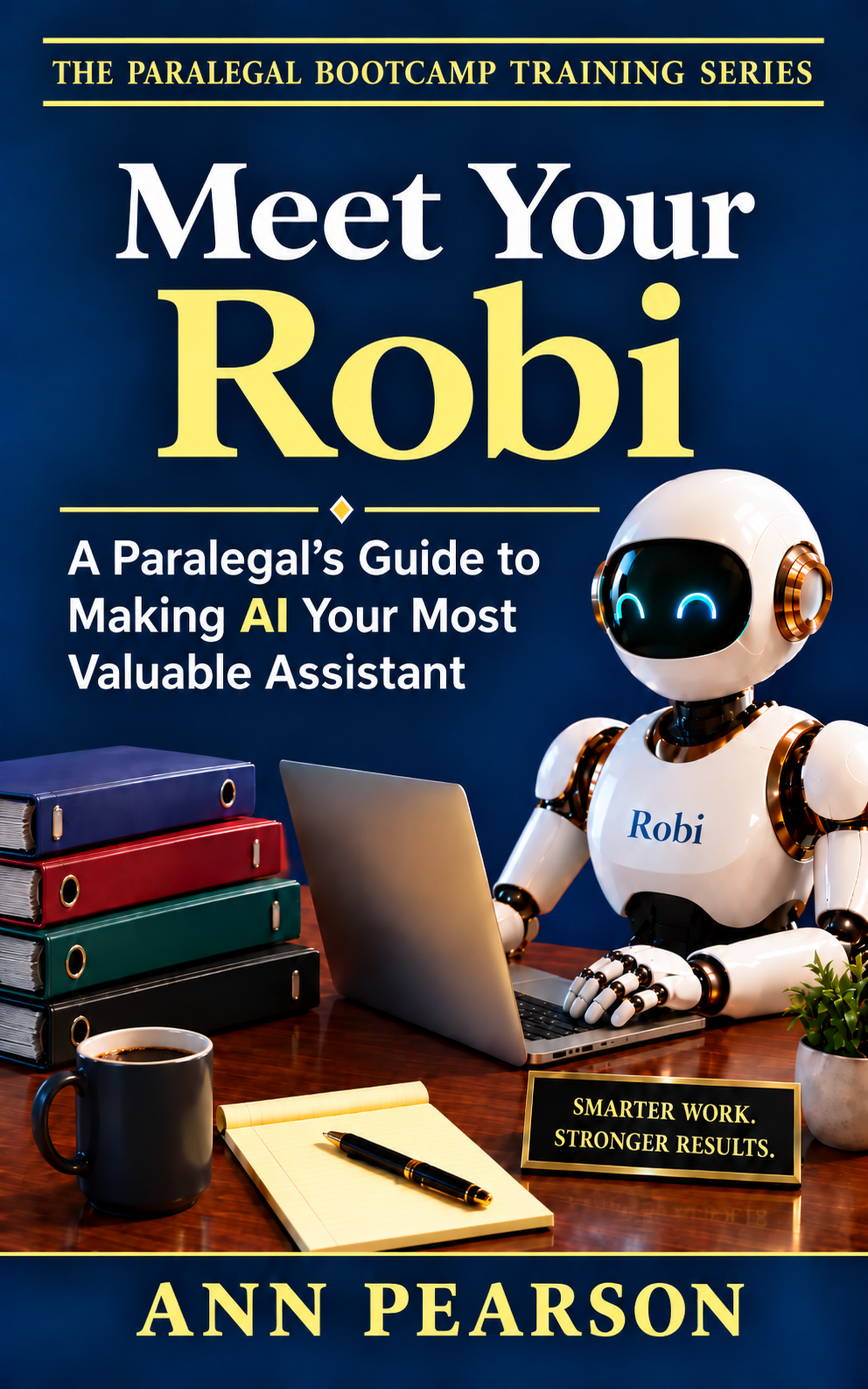
Meet Your Robi: A Paralegal’s Guide to Making AI Your Most Valuable Assistant is out now in paperback and on Kindle.
Inside the book you’ll find:
- A three-step method to Decide, Commit, and Implement
- My Career Accelerator Method for learning AI, using it strategically, and showing your firm the value you bring
- A 90-day starter plan you can follow on your own, plus real stories from paralegals who’ve made the leap
Three bonuses for readers who get the book by November 30, 2026
- Live implementation masterclass with me on Thursday, January 28, 2027, at 1:00 p.m. Eastern. By then you’ll have read the book and started your 90-day plan, so we’ll troubleshoot, sharpen your prompts, and plan your next 90 days together. Bring your questions, your stuck points, and your first wins.
- AI Prompt Library for Paralegals. Ready-to-use prompts organized by task, from client communications and research starting points to checklists, meeting prep, and file management. Every prompt comes with verification steps, so “supervision is step two” is already built in.
- AI Verification and Documentation Pack. Fillable templates you can use right away, including an AI Use Log to document what you used, when, and how you reviewed it, and an Output Verification Checklist to run before any AI-assisted work leaves your desk.
Claiming them is simple. Get your copy, paperback or Kindle, at ParalegalAIBook.com. Then go to MeetYourRobi.com, fill out the short form, and enter your Amazon order number.
You Bring What No AI Tool Has
The day Robi handed me an incomplete, messy trial prep checklist (twice), I learned that AI can’t replace what you know. A few months later, I learned how much AI can help you become an even better paralegal when you take the time to train it.
You bring years of judgment, the trial that settled the day before it started, and the attorney whose preferences you know by heart. Training your Robi is how you hand off the mundane work so you have more time for all of that, and I’d love for you to spend 15 minutes on your profile this week. I hope to see you in the masterclass in January.
More Paralegal Resources For You
Source
ABA Journal, “AI is the future of law, but most legal pros aren’t trained for it, a new report says” (April 17, 2025), reporting on the Thomson Reuters 2025 survey: https://www.abajournal.com/web/article/ai-is-the-future-of-law-but-most-legal-pros-arent-trained-for-it-a-new-report-says
Meet the Author

Ann Pearson is the Founder of the Paralegal Boot Camp and host of the Paralegal Coach Podcast Show. Ann is passionate about promoting the paralegal profession.
Ann spent 20 years working as a paralegal manager and a litigation paralegal before opening the Paralegal Boot Camp in 2010.
Ann’s training programs focus on adding immediate value to a paralegal’s career and bridging the gap between what a paralegal learns in school and what they actually do on the job.
Visit the About Us Page to learn more about why Ann started the Paralegal Boot Camp.