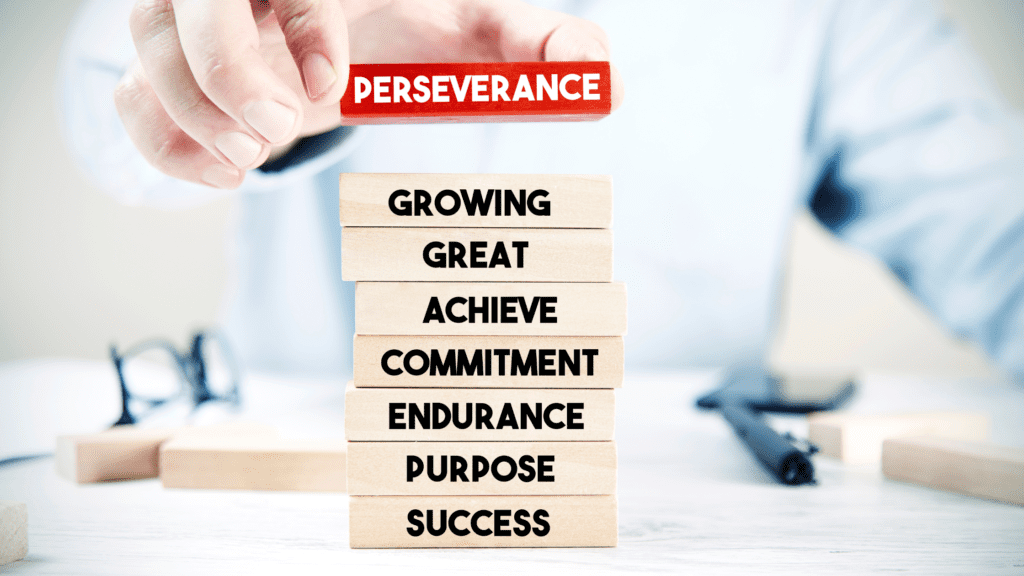
There are dozens of skills and habits that build a successful paralegal career, and we have covered a lot of them on this blog. Today I want to zoom in on three traits that quietly separate a good paralegal from a rockstar paralegal: accountability, professionalism, and perseverance.
Here is the best news about all three. Not one of them requires a certain degree, a certain number of years, or a certain practice area. Every one of them is a skill you can build on purpose, starting with your very next assignment.
Watch the Video Replay
1. Accountability
Do you have accountability? Notice that I did not ask whether someone is holding you accountable. I am asking whether you hold yourself accountable for your career, for the files you manage, for the projects you work on, and for the job you have right now.
What is Accountability Really Means
Let’s start with the definition so we are all on the same page. The dictionary tells us that accountability is the condition of being accountable, which is not exactly helpful, so let’s go one layer deeper. Being accountable is the willingness to accept responsibility and to answer for your own actions.
In plain English, accountability is taking ownership of what you do.
You own your work, your cases, your transactions, your closings, your trademark filings, and yes, that giant e-filing project. Whatever it is that you do as a paralegal, you own it.
It also means you own your wins and your mistakes. That second part is a superpower, not a weakness. Raising your hand early on a mistake gives your team the runway to fix it, and it builds trust faster than a perfect record ever could.
Read How Failure Can Benefit Your Paralegal Career.
Accountability vs. Responsibility
What is the difference between responsibility and accountability? Well, responsibility is what you HAVE to do. For example, it’s part of your job responsibility.
With accountability, you own it, and you make it happen. It’s a mindset that this project will not fail on my watch.
Same task. Completely different energy. And attorneys feel that difference immediately.
The Snowstorm, the Binders, and the Pedicab
Let me show you what that mindset looks like in action.
I had a paralegal in our NYC office who was the lead paralegal on a large commercial arbitration, and it was the middle of winter. One of the stipulations in the arbitration was that each side would exchange the exhibits they intended to use at least 24 hours in advance. I was working in the New York office that week, and we had several conversations, one of which was about the snowstorm heading our way.
The team’s routine was to prepare the exhibit notebooks and deliver them at the close of business or first thing the next morning so the exhibits could be used the following day.
You might be wondering why they did not simply deliver the entire week’s notebooks on Friday and be done with it. Both sides were playing the strategy game of not giving the other side too much advance notice of what was coming. Leave it to the lawyers to design that one.
Her attitude was simple: it is what it is, so I will figure out a way to make it work. And she did make it work seamlessly for weeks. Yes, weeks. They were five weeks in with at least another five to go, and she made a complicated daily exchange look effortless.
Then came the snowstorm.
Anyone who lives in a city that runs on public transportation knows what happens next. When the weather turns, finding a cab is nearly impossible. There was no rideshare app back then. It was old-fashioned yellow cabs only, and when it rained or snowed in New York City, you could stand out there a very long time waiting for a vacant light.
The delivery deadline was closing in. So this paralegal threw on her snow gear, grabbed her box of five-inch D-ring binders, sealed the box inside a garbage bag so nothing would get wet, and hailed a pedicab.
Yes, a bicycle with a plastic cover over the back seat. She called the other side’s paralegal on the way so they could meet her down the street to take the notebooks, because she was not about to lose her ride back to the office.
That project was not going to fail on her watch.
Accountability is stepping up to make sure the work is done on time and done right, regardless of your job title or who is officially in charge. It is one of the essential traits of a rockstar paralegal.
Learn how to be a confident paralegal.

Where Accountability Shows Up on a Regular Tuesday
Accountability is easy to spot in a snowstorm story. It is harder to spot on an ordinary day when nothing dramatic is happening. So here are three everyday moments where this trait quietly reveals itself, and how a rockstar paralegal handles each one.
Here are 10 Things Attorneys Look For in a Paralegal.
Moment 1: Feedback lands on your desk.
Feedback can sting for a second. That is human. The accountable move is to receive it as information rather than as a verdict on your worth. Some of the strongest paralegal teams I have worked with run on two-way learning. The paralegal with 30 years of institutional knowledge shares the history and the judgment calls, the paralegal with five years shares a faster workflow or a new tech shortcut, and everybody levels up. Staying curious is what keeps a long career current.
Moment 2: A policy feels inconvenient.
Every firm has procedures that seem like extra steps from where you sit. Before working around one, get curious about why it exists. Often there is a malpractice, ethics, or billing reason behind it that is not visible from your desk. And if a procedure truly has outlived its usefulness, the accountable move is to propose a better version rather than quietly skip it. That is how paralegals end up on process improvement committees.
Moment 3: Your numbers need attention.
If you work in a law firm, particularly on the defense side, entering your billable time is how the firm bills clients and collects the revenue that funds your paycheck and your bonus. So when an email arrives letting you know you are behind on time entry or tracking under target, treat it as useful data instead of criticism.
You may not control how much work lands on your desk. You absolutely control how consistently you capture your time, how clearly you communicate your capacity to your attorneys, and how proactively you raise your hand when your plate has room. Paralegals who own their numbers are almost always the ones having the strongest conversations at bonus time.

The paralegal billable hours numbers to know.
Litigation Paralegal Boot Camp
Are you tired of being the Panic Mode Paralegal who spends your days playing whack-a-mole with last-minute rush projects because you’re waiting for someone to show you what it takes to be a great litigation paralegal?
This is the only program of its kind that provides litigation paralegals with all of the tools to master litigation cases from the complaint through the trial, and everything in between.
You will be the Confident Case Strategist faster than you ever imagined possible.
And I will be there guiding you to the finish line!
Owning Your Career Is Accountability, Too
Here is the piece of accountability that changes everything: taking ownership of your career. I talk about this a lot. I know! But it is that important to your success.
Did you not get the on-the-job training you were promised? Go get it yourself.
Is your firm expecting you to cite-check and e-file summary judgment briefs, but no one has shown you how? Go get the training.
When you have accountability for your career, you understand that you have more influence over your success than anyone else in the building.
In Stephen Covey’s 7 Habits of Highly Effective People, he reminds us that we always have the ability to choose our response to a situation.
I watched a TEDx talk recently by Janyssa Berrios. She told the story of being an okay soccer player for ten years. She never really pushed herself and was never consistent in practice, and okay was good enough at that point in her life. Then one day she decided to start holding herself accountable. She switched to wrestling, went all in, and became the first female wrestler from her school to earn a college wrestling scholarship.
One line from that talk has stayed with me. We all say that actions speak louder than words, but we forget that there are also consequences for our inaction.
So here is the encouraging way to look at it. What is one action you could take this month that your future self would thank you for?
How to Raise Your Accountability Level
Consider this your friendly nudge, not a lecture. Life happens to every single one of us. We start the year with big goals, and then a trial gets moved up, a family situation takes priority, and suddenly five years have gone by since we set the goal to earn that certification or finish that degree.
Do these three things to raise your accountability level:
- Be consistent. Small repeated actions beat occasional bursts of effort every time.
- Take ownership of your career, your projects, and your mistakes.
- Welcome feedback, and take it a step further by actively asking for it.
And when the excuses creep in (and they creep in for all of us), here is how to move through them.
Turn Roadblocks Into Solutions
You have probably heard yourself say one of these:
The attorney did not give me clear enough instructions.
No one has ever taken the time to show me how to do it.
The attorney waits until the last minute to assign tasks to me.
Every one of those is a real friction point. The rockstar move is to treat each one as a problem to solve rather than a wall to stand behind. Here is the two-step process.
Step 1. Write them down and look for patterns.
Do they sound similar? Are they all different? Is the pattern that at least one shows up every single day? Patterns tell you where to aim your energy.
Step 2. Find a solution to each one.
An excuse is usually a problem in disguise. I wrote an entire blog on How to be a Problem-Solving Paralegal, because problem-solving is the number one skill attorneys tell me they look for in their paralegals.
One of my favorite techniques is the one journalists use to make sure a story is complete: the five W’s and one H. Let’s run it on the roadblock of unclear instructions.
- WHO else could you ask for clarification on this project?
- WHAT were the instructions you were actually given?
- WHEN in the process did you realize you needed more direction?
- WHERE could a template, checklist, or prior work product fill the gap?
- WHY did the project go sideways? Are you certain it was the instructions and not something else?
- HOW can you prevent this from happening on the next assignment?
That last question is where the growth lives. Maybe the answer is a five-minute intake conversation at the start of every new assignment. Maybe it is a one-page assignment sheet you create and hand to your attorney. Either way, you just built a workaround, and that is exactly what it looks like to be a proactive paralegal.
Accountability keeps you looking for the alternative solution, the plan B, instead of stopping at the first obstacle. I have seen this trait in every rockstar paralegal I have ever worked with.
Get more tips on how to be a proactive litigation paralegal.
Free Guide for
Personal Injury Paralegals
Are you ready to be a rockstar personal injury paralegal?
When you’re starting out, it’s hard to know where to even start. We’ve got you covered! Here is your checklist.
The Paralegal Boot Camp gives you 8 actionable steps to get you started right now on a path to success.
Our free guide shares the 8 steps you need to take right now to start standing out at your firm.
2. Professionalism
When we hear the word professionalism, most of us, myself included, immediately think about how we dress, how we present, and how we behave in front of a client, colleagues, or a judge. Those things matter. But I am talking about something deeper: internal professionalism, the version that rarely gets discussed but always gets noticed.
What Professionalism Really Looks Like:
- Confidence
- Work ethic
- Reality
- A positive attitude
It is handling stress and pressure with grace. In other words, being the calm and not the storm.
It is being a team player who collaborates for the client’s benefit. That means helping your fellow paralegals, and not just so they avoid a misstep. You help them because when another paralegal shines in front of the attorneys, the entire paralegal profession gets elevated. That is the opposite of the scarcity mindset, and it is one of the most attractive qualities a legal professional can have.
Professionalism is also choosing to be the person who builds people up rather than joining the venting circle. You can absolutely be a safe place for a colleague who is having a rough day while still steering the conversation toward solutions. Your reputation is built one conversation at a time, and the person known for lifting the mood is the person who gets invited into bigger opportunities.
Here is more on how to combat negativity in the workplace.
And professionalism is going above and beyond what is expected because you take genuine pride in your work.
A Real-World Example of Professionalism
When I think about professionalism, I think about the interview I did with Kim Bookout. She was a paralegal of mine back when I was a paralegal manager, and she was the definition of professionalism. I could not have put words to it back then, but during our interview it became crystal clear.
One of her actionable strategies for career mobility was beautifully simple: be kind to every single person you come into contact with, because you never know when that vendor becomes your future boss or the paralegal down the hall becomes your future client. She shares excellent examples of what this trait looks like day-to-day.
Read the Interview with Kim Bookout on where your litigation career path can take you.
3. Perseverance
LifeHack.org defines perseverance as continuing to do something despite the difficulty or the delay involved in reaching success.
I define it a little differently. Perseverance is the ability to handle the curveballs and keep moving toward what you want.
Think about that in terms of your paralegal career. I have done quite a few interviews for our paralegal inspiration podcast series, and perseverance comes up again and again as a shared trait of rockstar paralegals. Many of them started in a role that was not a great fit, and rather than walking away from the profession, they adjusted. They moved to a different practice area, a different firm, or a different team inside the same firm. They kept going until they landed in the dream job that fit them.
Perseverance also shows up as:
- The ability to pivot
- Adaptability
- Flexibility
Those three qualities are what allow you to find solutions when the first plan does not work. And in a profession that is changing as quickly as ours is right now, the ability to adapt may be the single most valuable career asset you own.
Put All Three Together
Now combine all three traits of a rockstar paralegal into one person. Accountability, professionalism, and perseverance. That paralegal is headed for a successful and satisfying career, and I have zero doubt about it.
I would add one more to the list: patience. Careers are built over years, not weeks. Bring these three traits plus a little patience, and there is truly no stopping you.
Pick just one of the three to focus on this month. Write down one specific action for it, put it on your calendar, and let your future self collect the reward.
Learn how to balance being a mom and a rockstar paralegal.
Ready to build the skills that go with the mindset? Take a look at the Paralegal Boot Camp training programs and pick the one that fits the career you are building.
Meet the Author
Ann Pearson is the Founder of the Paralegal Boot Camp and host of the Paralegal Coach Podcast Show. Ann is passionate about promoting the paralegal profession.
Ann spent 20 years working as a paralegal manager and a litigation paralegal before opening the Paralegal Boot Camp in 2010.
Ann’s training programs focus on adding immediate value to a paralegal’s career and bridging the gap between what a paralegal learns in school and what they actually do on the job.
Visit the About Us Page to learn more about why Ann started the Paralegal Boot Camp.